


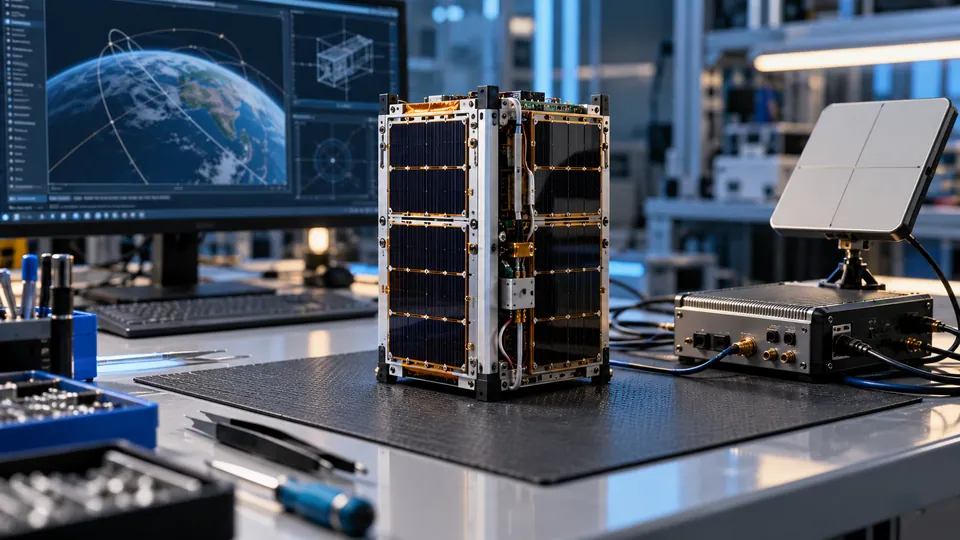
The sector challenge
A mission is a connected system, not a collection of subsystems.
A payload objective affects data volume, power, communications, pointing and operations. Small spacecraft make these dependencies particularly visible: a change in one budget or interface may remove margin elsewhere. Learning mission design requires a consistent architecture and an explicit account of assumptions.
The programme is developing a shared mission-design and simulation framework that connects academic and industrial engineering perspectives. Requirements, subsystem interfaces, resource budgets and verification evidence are treated as one connected design problem.
Programme development priorities
- Translate a mission purpose into requirements and a Concept of Operations.
- Examine interfaces and feasibility margins across a preliminary architecture.
- Use simulation and a controlled demonstrator to expose technical risks and learning needs.
Technical scope & method
A structured approach to the question.
- 01Mission definition
- Set objectives, user needs, constraints and a mission Concept of Operations (ConOps). Establish what the exercise will and will not attempt to demonstrate.
- 02Space-segment architecture
- Outline a CubeSat-class payload, subsystem interfaces, onboard data handling, attitude and orbit-control considerations. Keep power and communications budgets consistent with the assumed mission scenario.
- 03Ground and operations concept
- Define ground-station functions, command and telemetry interfaces, contact assumptions and mission-operations roles. Controlled and simulated exchanges support interface development and review.
- 04Verification and review
- Map requirements to analysis, simulation or demonstration evidence. Track margins, unresolved interfaces and technical risks before considering further development.
- 01Mission objectivesRequirements and ConOps
- 02Space segmentPayload, power, data and pointing
- 03Ground segmentLink, command and telemetry concept
- 04Verification modelSimulation evidence and risk review
Pilot development & application
CubeSat-class architecture and ground-segment simulation.
Mission-design development uses a CubeSat-class reference architecture with a defined payload objective and a controlled ground-segment demonstrator. The work connects requirements, power and link budgets, onboard data handling and selected command-and-telemetry exchanges. Simulation makes dependencies and feasibility margins visible before flight-related decisions.
Baseline the concept
Agree objectives, assumptions, requirements and interfaces. Make the synthetic mission and the limits of the exercise explicit.
Analyze the architecture
Develop example power and link budgets, data flows and simulation cases. Examine how changes in payload or contact assumptions affect the design.
Review evidence and risks
Demonstrate selected command/telemetry exchanges and check requirements traceability. Record margins, interface inconsistencies and the engineering requirements informing mission development.
Development connects a defined application, measurable criteria and a traceable technical review.
Technical deliverables
Outputs and evaluation.
The development workstreams connect these deliverables to reviewable evidence and application-specific evaluation criteria.
- Mission concept study
- Requirements baseline
- Preliminary system architecture
- Interface description
- Link and power budget examples
- Simulation plan
- Ground-segment demonstrator specification
- Technical review report
Evaluation priorities
- System consistency
- Requirements, interfaces and budgets agree across the architecture.
- Feasibility margins
- Assumptions, resource margins and sensitivity to design changes are visible.
- Verification coverage
- Simulation and demonstration cases address the selected requirements and expose remaining risks.
Participation & boundaries
The right expertise. Clear responsibilities.
The collaboration framework defines contributions from universities, spacecraft and payload engineers, software specialists and ground-segment practitioners. Review responsibilities follow the mission architecture, its interfaces and the evidence required from each workstream.
Scope and safeguards
Flight and radio-frequency activities require their applicable authorizations, communications licensing, spectrum coordination, export-control review and safety arrangements. These requirements are considered alongside the technical architecture.
Mission ownership, launch arrangements and operational responsibility must be established through their own competent processes. Design and simulation evidence support, rather than replace, those decisions.
Participation and technical decisions remain separate.
Participation does not automatically confer membership rights, AF Recognition, accreditation, certification, standards-setting authority or procurement preference. Sponsorship must not determine technical conclusions, evaluation results or governance decisions.
Development pathway
Development, grounded in evidence.
Technical objectives, responsible coordination and application needs shape the development process. Resources, safety, confidentiality, data protection, intellectual property and reporting arrangements are reviewed alongside the methods and deliverables, keeping progress focused and accountable.
A structured development pathwayExplore the seven connected development stages
Programme development connects technical requirements, responsible coordination and reviewable evidence. Each stage informs the next, while review findings refine the scope, methods and priorities.
- Requirements & Objectives
Define the technical problem, user need and scope.
- Feasibility & Evidence
Examine methods, resources, interfaces and dependencies.
- Scope & Responsibilities
Align workstreams, coordination and review arrangements.
- Pilot Development
Connect the evaluation plan to funding, safety, data and intellectual-property controls.
- Controlled Implementation
Maintain the agreed technical boundary and responsible delivery arrangements.
- Technical Evaluation
Review evidence and outcomes against application-specific criteria.
- Knowledge & Further Development
Translate reviewed findings into useful outputs and the next development priorities.