

About the Federation
Scope & Coverage
The aerospace fields and capabilities within the Federation's institutional scope.
Institutional reach
A broad field, held within a clear institutional scope.
Aerospace includes far more than aircraft and spacecraft. It brings together operations, industrial capability, digital systems, research, education, technical evaluation and the people who sustain them.
Aerospace Federation provides a common setting for these connected fields. Its scope describes where the Federation may build relationships and relevant programmes; it does not mean that every field is already the subject of a technical project, accreditation route or active event.
Understand the distinction
Institutional reach is not programme availability.
A field may be within the Federation’s scope without an open activity, published standard or assessment route.
Check the activity, not only the domain
Use the relevant programme page to identify current status, technical boundaries and participation arrangements. Broad aerospace relevance is not enough to establish eligibility.
Technical focus mapCheck the assessment scope
An Accreditation conclusion applies to specified activities, methods and conditions. It cannot be extrapolated to every service offered by an organization.
Scope areasWhy scope matters
Clarity keeps a cross-sector federation coherent.
Aviation, space and emerging mobility share capabilities and questions, but they do not operate under identical rules or institutions. A defined scope helps participants understand where their expertise is relevant, where disciplines intersect and which Federation pathway is appropriate.
Scope areas
Eight connected domains of aerospace capability.
The areas below are a practical map of institutional reach, not a claim that all activities are interchangeable or that each has an open programme.
Aviation
Civil aviation, aircraft systems, avionics, airports, ground systems, maintenance, operations and safety-related technical fields.
Space
Spacecraft, satellites, launch systems, ground segments, mission operations and the sustainable use of space.
UAS & Advanced Air Mobility
Uncrewed and autonomous aircraft, eVTOL, supporting infrastructure and emerging mobility systems.
Industry & Manufacturing
Manufacturers, suppliers, materials, propulsion, electronics, structures, advanced production and supply-chain capability.
Technical Assurance & Evaluation
Safety, quality, testing, verification, validation, qualification, reliability and inspection-related capability.
Digital Aerospace
Software-intensive systems, AI, cybersecurity, digital engineering, autonomy and data-driven capability.
Research, Education & Professional Development
Universities, research institutions, competence, professional communities, knowledge development and Aerospace Academy activity.
Sustainability & Lifecycle
Environmental responsibility across aviation and space, lifecycle thinking, circularity and orbital sustainability.
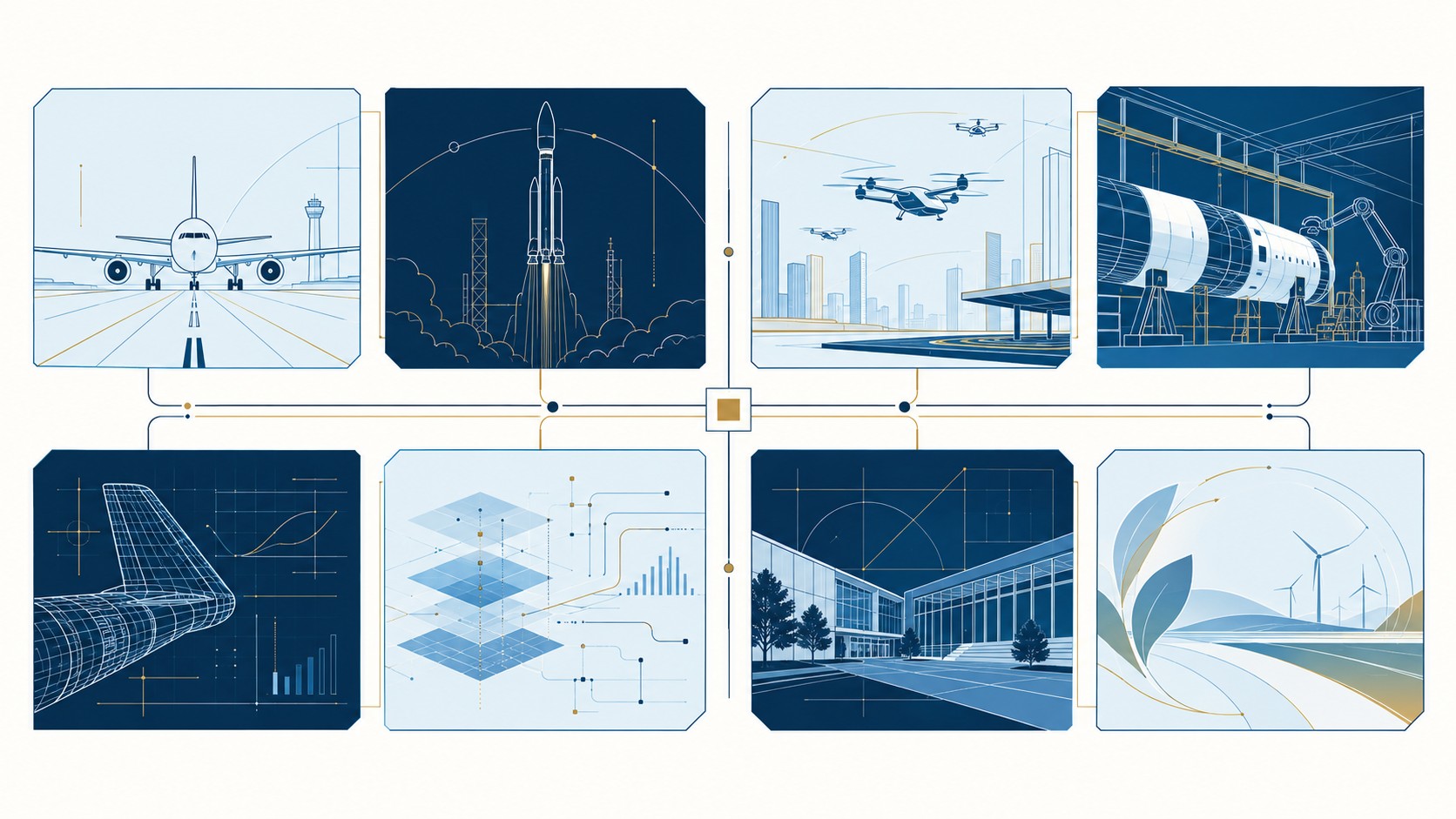
The scope map
Separate domains form one connected aerospace landscape.
Industrial and digital capabilities support both flight and space activity. Assurance, research and education cut across them; sustainability is a lifecycle consideration rather than a separate destination. The map makes those relationships visible while keeping each domain identifiable.
From scope to work
Coverage and technical focus serve different purposes.
| Question | Scope & Coverage | Technical Work |
|---|---|---|
| What it defines | The wider aerospace fields within the Federation's institutional reach. | A particular technical question or focus area selected for structured work. |
| How it is used | To explain relevance, connections and possible routes for participation. | To organize expertise, evidence, review and a proportionate output. |
| What it does not imply | Automatic activity or authority in every listed field. | A mandatory standard or a decision about an organization merely because a topic is in scope. |
Explore Technical Work Focus Areas See the Global Aerospace Ecosystem
Participation across scope
Different participants connect through different roles.
An operator may bring operational experience; a manufacturer may contribute industrial knowledge; a laboratory may bring evaluation capability; a university may support research and learning. Professionals and emerging talent add perspectives of their own. The relevant route depends on the participant and the activity, not on a universal template.
Participation and knowledge
Membership establishes a formal relationship. Technical Work and Publications provide distinct routes for expertise and outputs where appropriate.
Assurance and engagement
Accreditation has its own defined assessment routes. Activities and the Aerospace Academy create settings for exchange and learning.